


 Tel:
 Email:
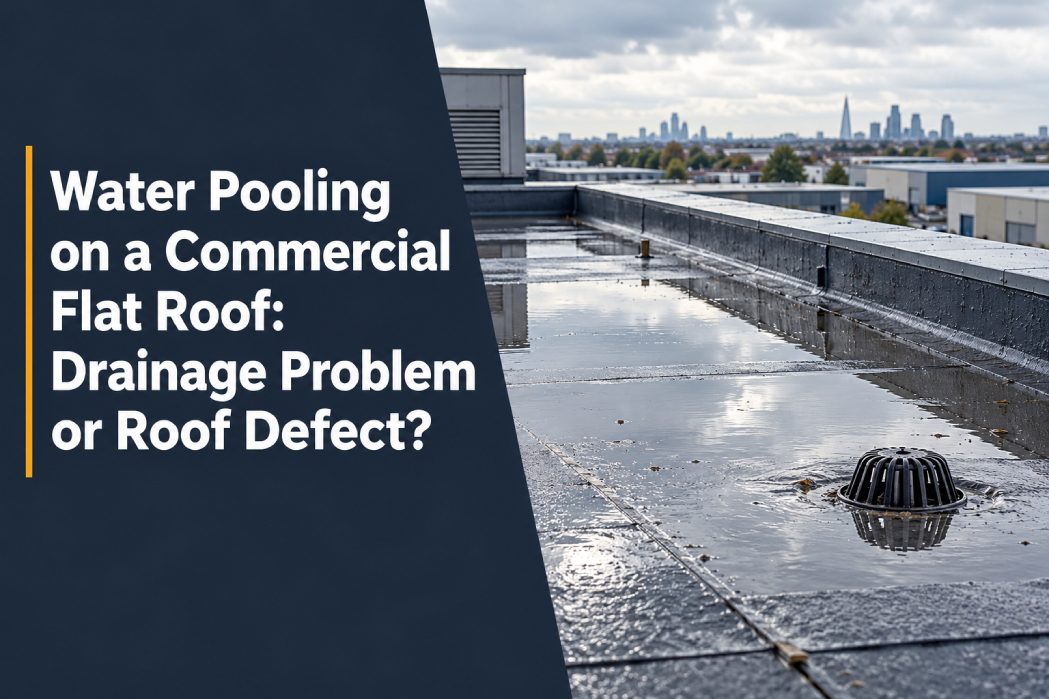
Water pooling on a commercial flat roof is something that property owners and facilities managers should never ignore. Although flat roofs are designed to accommodate rainfall, water should be able to drain away through the appropriate outlets and drainage systems. When water remains on the surface for an extended period, it can indicate that something is preventing the roof from functioning as intended.
At RoofPro, we understand how important a reliable roofing system is for commercial properties. From offices and warehouses to retail premises and other business buildings, the roof plays a vital role in protecting the structure, its contents and the people using it.
One of the challenges with standing water is that the underlying cause is not always obvious.
A blocked outlet may prevent rainwater from leaving the roof, while an inadequate fall can allow water to collect in particular areas. In other cases, the problem may be associated with the condition of the roof covering or changes to the supporting structure.
These issues can look similar from the ground, but they may require very different solutions.
At RoofPro, we provide commercial roofing inspections, repairs and installation services, helping businesses identify roofing problems and determine the most appropriate course of action.
In this guide, we explain why water collects on commercial flat roofs, how to distinguish drainage problems from roofing defects and when professional assessment may be necessary.
Is It Normal for Water to Pool on a Flat Roof?
Despite the name, a flat roof is not necessarily completely level.
Commercial flat roofs are generally designed with a slight fall to direct rainwater towards suitable drainage points.
This allows water to move away from the roof surface rather than collecting indefinitely.
However, it is not unusual for small amounts of water to remain temporarily after rainfall.
The important consideration is whether the water drains away as expected or repeatedly collects in the same locations.
At RoofPro, we recommend paying attention to standing water that remains for an extended period, particularly when the surrounding roof has already dried.
Persistent pooling is commonly referred to as ponding water.
It may indicate a problem with the drainage system, the roof's falls or the condition of the roof itself.
However, the presence of standing water does not automatically mean that the waterproof covering has failed.
A roof may retain water because an outlet is blocked, even when the covering remains intact.
Equally, a roof may have a clear drainage system but still experience pooling because the surface does not direct water towards the outlets effectively.
Understanding the cause is essential before deciding what work is required.
What Causes Water to Pool on Commercial Flat Roofs?
There are several reasons why rainwater may collect on a commercial flat roof.
Some relate to maintenance, while others are associated with the roof's construction or condition.
At RoofPro, our commercial roofing services include repairs, guttering work, roof surveys and the installation of different flat roofing systems.
This experience allows us to consider the wider roofing arrangement rather than concentrating only on the visible water.
One possible cause is a blocked drainage outlet.
Leaves, moss, dirt and other debris can accumulate around outlets and prevent rainwater from flowing away efficiently.
Another possibility is that the roof does not have sufficient falls towards its drainage points.
If water cannot move naturally towards an outlet, it may remain in low areas.
The condition of the roof covering can also be relevant.
For example, damage, blistering or deterioration may affect the surface and create areas that require attention.
In some situations, movement or changes in the supporting structure can contribute to unevenness.
These causes should not be treated as interchangeable.
A drainage blockage may require relatively straightforward maintenance, while an issue involving the roof structure or waterproofing system may need more extensive investigation.
Could Blocked Gutters or Outlets Be the Problem?
Blocked drainage is one of the first possibilities worth investigating when water starts collecting on a commercial flat roof.
Rainwater needs a clear route away from the roof.
Depending on the building, this may involve internal outlets, external gutters, downpipes or a combination of drainage components.
When these become obstructed, water can accumulate around the affected areas.
At RoofPro, we provide commercial guttering repair services alongside our wider roofing work.
We understand that drainage components are an essential part of the overall roofing system.
A roof covering may be in reasonable condition, but if the drainage system is unable to remove rainwater effectively, the building can still experience problems.
For example, an outlet partially blocked by leaves may allow some water through while slowing the drainage process.
Following heavier rainfall, this can result in a larger area of standing water.
However, a blockage should not be assumed without inspection.
If the drainage system is clear but water continues to collect, the problem may lie elsewhere.
Professional assessment can help establish whether maintenance is sufficient or whether additional roofing work is required.
How Can You Tell Whether Drainage Is the Main Issue?
The location and pattern of pooling can provide useful clues.
For example, water collecting immediately around an outlet may suggest that the drainage point is not functioning as intended.
Similarly, overflowing gutters or visible debris around drainage areas may indicate a maintenance problem.
However, these observations do not provide a complete diagnosis.
At RoofPro, we recommend considering how the roof behaves after rainfall.
Does water collect in the same location every time?
Does it appear around a drainage point, or is it concentrated in the middle of the roof?
Has the problem developed recently, or has it been present for several years?
These details can help establish the circumstances surrounding the issue.
It is also useful to consider whether there have been recent changes to the building.
For example, alterations to rooftop equipment or previous roofing work may have affected how water moves across the surface.
However, property owners should avoid attempting to investigate inaccessible roof areas themselves.
Commercial roof inspections should be carried out using appropriate access arrangements and safety precautions.
Our team can assess the relevant areas and discuss the findings.
What If the Roof Has Inadequate Falls?
A flat roof relies on suitable falls to direct water towards drainage points.
If the surface does not slope effectively, water may collect in low areas even when the outlets are clear.
This can occur because of the original roof design, the way the roof was constructed or changes that have developed over time.
At RoofPro, we install and repair several types of commercial flat roofing systems, including felt roofing and single ply membranes.
When considering a persistent pooling problem, it is important to assess the relationship between the waterproof covering, the supporting structure and the drainage arrangement.
Simply clearing an outlet will not resolve a low area that prevents water from reaching it.
Likewise, applying a local repair to the roof covering may not address the underlying drainage pattern.
Where inadequate falls are contributing to the problem, a more detailed assessment may be required.
The appropriate solution will depend on the existing construction and the condition of the roofing system.
Our approach is to understand the cause before recommending repairs or replacement.
Can Water Pooling Indicate a Roof Defect?
Yes. In some circumstances, standing water may be associated with a defect in the roof.
However, it is important to distinguish between water collecting on the surface and water entering the building.
A waterproof roof covering should provide protection against rainfall, but damage or deterioration can create vulnerable areas.
At RoofPro, our commercial felt roofing guidance identifies tears, cracks and bubbling as issues that may require repair.
These defects should be assessed promptly because leaving them unattended can allow the condition of the roof to deteriorate further.
If water repeatedly collects around a damaged area, the situation deserves particular attention.
Standing water can make it more difficult to identify the condition of the underlying surface.
It may also increase the consequences of an existing weakness in the waterproof covering.
However, water pooling alone does not prove that the membrane has failed.
The roof should be inspected to establish whether there is an actual defect and whether it is connected to the drainage problem.
What Are the Warning Signs of a Commercial Flat Roof Defect?
Persistent standing water is one warning sign, but it should be considered alongside the wider condition of the roof.
At RoofPro, our existing articles emphasise the importance of regular inspections and identifying roofing problems before they become more serious.
Visible cracks, tears or bubbling in a felt roof may indicate that repairs are required.
Other concerns may include damaged joints, deteriorating details around roof penetrations or signs of water entering the building.
Inside the property, unexplained damp patches, staining or water damage may suggest that the roofing system needs attention.
However, the location of an internal leak does not always correspond directly with the point where water enters the roof.
This is one reason why professional investigation is important.
A visible symptom may be connected to a problem elsewhere in the roofing system.
At RoofPro, we recommend assessing the roof as a whole rather than relying on a single sign to determine the cause.
Why Standing Water Should Not Be Ignored
It can be tempting to dismiss water pooling if the building has not developed an obvious leak.
However, persistent ponding deserves attention even when the interior appears dry.
Water collecting repeatedly in the same location may indicate that the roof is not draining as intended.
If the problem is caused by blocked outlets, the obstruction may worsen as additional debris accumulates.
If inadequate falls are responsible, the pooling may continue whenever it rains.
Where the waterproof covering is already damaged, standing water may increase the importance of carrying out timely repairs.
At RoofPro, we believe that addressing roofing concerns early is an important part of protecting commercial buildings.
Our commercial roofing maintenance guidance highlights the value of regular inspections and preventative work.
Identifying problems before they develop into larger repairs can help businesses manage their roofing responsibilities more effectively.
However, the appropriate response depends on the condition of the roof.
Not every instance of pooling requires a complete replacement.
A professional assessment can help determine whether maintenance, local repairs or more extensive work is appropriate.
Can Pooling Water Damage a Commercial Flat Roof?
The potential consequences depend on the roofing system and the cause of the pooling.
Commercial flat roofs are constructed using different materials, each with its own characteristics.
At RoofPro, we work with felt roofing, single ply systems, hot melt roofing and other commercial roofing solutions.
These systems are designed to provide waterproof protection, but their suitability depends on correct specification, installation and ongoing condition.
Persistent standing water may expose weaknesses in an ageing or damaged roof covering.
It can also make routine maintenance more difficult if debris collects in low areas.
Where water is unable to drain effectively, the additional load may also need to be considered.
The seriousness of the situation will depend on the amount of water, the roof structure and the wider condition of the building.
For this reason, significant or recurring pooling should be assessed rather than treated as a purely cosmetic issue.
Our team can discuss the available inspection and repair options.
How Do Different Flat Roofing Materials Affect the Problem?
Commercial flat roofs can be constructed using several different waterproofing systems.
At RoofPro, our services include felt roofing, single ply roofing and hot melt roofing.
Each system has different installation requirements and repair considerations.
For example, our commercial felt roofing service uses modified bitumen materials reinforced with fibreglass or polyester.
Our website explains that common issues such as tears, cracks and bubbling can often be repaired, depending on the condition of the roof.
Single ply roofing provides another approach to waterproofing commercial flat roofs.
However, the presence of ponding water should not automatically be attributed to the type of membrane installed.
A roof can experience drainage problems regardless of the covering material if its outlets are obstructed or its falls are inadequate.
Likewise, a membrane defect may require attention even when the drainage system is functioning correctly.
At RoofPro, we assess the existing roofing system before recommending a suitable repair method.
This helps ensure that any proposed work is appropriate for the materials already installed.
Can a Flat Roof Be Repaired Without Being Replaced?
In many circumstances, commercial flat roof problems can be addressed through repairs rather than complete replacement.
At RoofPro, we provide commercial roofing repair services and work with a variety of roofing materials.
Our commercial felt roofing guidance explains that certain defects, including cracks and tears, can often be repaired.
However, the suitability of a local repair depends on the extent of the damage and the overall condition of the roof.
For example, a small area of damaged covering may be suitable for targeted work.
By contrast, widespread deterioration or a more fundamental problem with the roof construction may require a different approach.
The same principle applies to drainage.
A blocked outlet may be resolved through appropriate maintenance, but an underlying problem with the roof's falls may require more substantial work.
We recommend avoiding temporary solutions that address only the visible symptoms.
A successful repair should take account of the cause of the problem and the condition of the surrounding roofing system.
When Might a Commercial Flat Roof Need Replacing?
A complete roof replacement may be appropriate where the existing covering has deteriorated extensively or where repairs are unlikely to provide a satisfactory long-term solution.
At RoofPro, we understand that replacement is a significant decision for commercial property owners.
It can involve financial planning, access arrangements and consideration of how the work may affect the building's occupants.
This is why we recommend establishing the condition of the roof before making a decision.
Our commercial roofing services include installation and replacement work using suitable roofing systems.
However, standing water should not automatically lead to a recommendation for a new roof.
If the main problem is a blocked drainage outlet, replacement may be unnecessary.
If the roof has widespread defects alongside persistent drainage problems, more extensive work may be justified.
The appropriate recommendation should reflect the findings of a professional inspection.
How Can a Commercial Roof Inspection Help?
A professional roof inspection is an important step when the cause of pooling water is unclear.
At RoofPro, we offer roofing inspections and drone roof surveys as part of our wider services.
Our existing blog articles explain how inspections help identify roofing problems and assess the condition of a building's roof.
For commercial properties, this can be particularly valuable where the roof is large or difficult to access.
A survey can help establish where water is collecting and whether visible defects are present.
It may also identify concerns involving roof coverings, drainage points or other roofing details.
However, not every problem can be diagnosed from photographs or a visual overview alone.
Some issues require closer inspection to establish the underlying cause.
At RoofPro, we consider the available evidence before discussing the next steps.
The aim is to provide property owners with a clearer understanding of the roof's condition and the work that may be required.
What Role Do Drone Roof Surveys Play?
Drone roof surveys can provide a useful overview of commercial roofing areas.
At RoofPro, we offer commercial drone roof survey services and have discussed their benefits in our existing blog content.
For large buildings, a drone can help capture images of areas that may be difficult to inspect from ground level.
This can be useful when identifying the general location of standing water or reviewing visible roofing conditions.
However, drone surveys have limitations.
Photographs may show where water has collected, but they cannot always establish why the problem has occurred.
For example, a visible pool of water may be caused by inadequate falls, a drainage obstruction or another issue requiring closer investigation.
A drone survey should therefore be considered part of the assessment process rather than a guaranteed method of diagnosing every defect.
At RoofPro, we can discuss which inspection approach is appropriate for the property.
Why Regular Commercial Roof Maintenance Matters
Preventative maintenance plays an important role in keeping commercial roofing systems in good condition.
At RoofPro, our existing blog content highlights the benefits of regular commercial roofing maintenance.
Routine inspections provide opportunities to identify developing problems before they become more serious.
For flat roofs, this may include checking drainage areas, reviewing the condition of the waterproof covering and looking for signs of damage.
Regular attention is particularly valuable after periods of severe weather.
Heavy rainfall can reveal drainage weaknesses that may not be obvious during dry conditions.
Similarly, fallen leaves and other debris may accumulate around gutters and outlets.
At RoofPro, we recommend taking a proactive approach rather than waiting until water enters the building.
A well-planned maintenance approach can help property owners understand the condition of their roof and respond to problems appropriately.
It also provides useful information when planning future roofing work.
What Should Facilities Managers Do When They Notice Pooling?
If you are responsible for a commercial building and notice persistent standing water, the first step is to record what you have observed.
Note when the pooling occurs, where it is located and whether it appears to be getting worse.
Photographs taken from a safe location may also be useful.
However, do not attempt to access a commercial roof without appropriate safety arrangements.
At RoofPro, we recommend arranging a professional assessment when pooling is persistent, extensive or accompanied by other signs of roofing problems.
It is also worth checking whether the building has a history of drainage issues or previous roof repairs.
Existing maintenance records may help establish whether the problem is new or recurring.
If water is entering the building, prompt action is particularly important.
Our commercial roofing team can discuss the circumstances and advise on suitable next steps.
The priority should be to establish the cause rather than immediately assuming that a particular repair is required.
Why Choose RoofPro for Commercial Flat Roofing?
At RoofPro, we provide commercial roofing services for businesses across London and the surrounding areas.
Based in Teddington, we work on a wide range of commercial and domestic roofing projects.
Our services include felt roofing, single ply roofing, hot melt roofing, green roofing, repairs, guttering work and drone roof surveys.
This allows us to consider different aspects of a commercial roofing system when assessing problems such as persistent standing water.
We understand that businesses need roofing solutions that are practical, reliable and appropriate for their buildings.
Our company is built on reputation, and we have completed a wide range of commercial and domestic projects.
For additional reassurance, we are registered NFRC contractors, CHAS approved and members of the Competent Roofers Scheme.
We also offer free, no-obligation quotations for commercial roofing work.
Whether you are dealing with a drainage concern, a damaged roof covering or an ageing flat roof, our team can discuss your requirements.
Water Pooling on Your Commercial Flat Roof? Contact RoofPro
So, is water pooling on a commercial flat roof a drainage problem or a roof defect?
The answer depends on the circumstances.
Blocked gutters and outlets can prevent rainwater from leaving the roof, while inadequate falls may allow water to collect even when the drainage system is clear.
In other situations, standing water may be associated with deterioration or defects in the roofing system.
The important point is that persistent pooling should not be ignored.
At RoofPro, we believe that identifying the underlying cause is essential before deciding whether maintenance, repairs or replacement work is required.
Our experienced commercial roofing team can assess your roof, discuss the available options and help you understand the next steps.
Whether your property requires guttering repairs, attention to an existing flat roof or a more comprehensive roofing solution, we are here to help.
Concerned about water pooling on your commercial flat roof? Contact RoofPro on 020 3645 3313 or email office@roofpro.co.uk to discuss your roofing requirements and request a free, no-obligation quotation.
