0 GBP 0.00
products in your basketto quote Checkout
Ooops no items were found.
Try something else.
Ok
Loading…

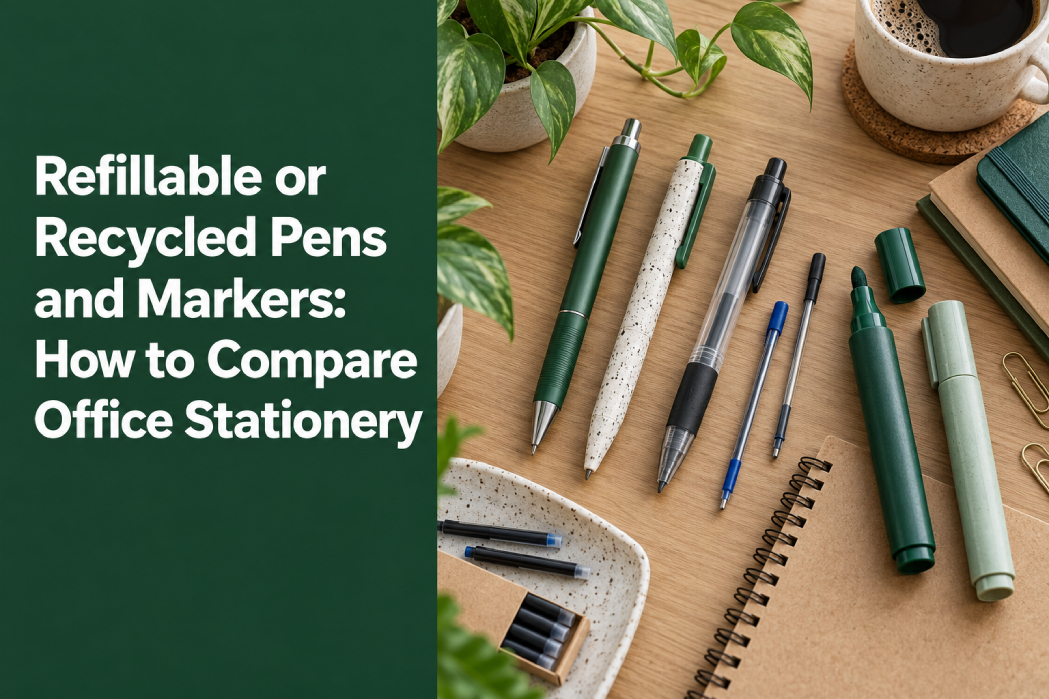
Refillable or Recycled Pens and Markers: How to Compare Office Stationery

Choosing more sustainable office stationery is not always as straightforward as replacing conventional products with alternatives labelled as environmentally friendly. When it comes to pens and markers, businesses are often faced with two options: products manufactured using recycled materials and products designed to be refilled and reused.

Both approaches can offer environmental advantages, but they address different aspects of stationery consumption. Recycled pens make use of recovered materials, while refillable pens allow the main body of the product to remain in use after the original ink has been exhausted.

At The Green Stationery Company, we believe that making responsible purchasing decisions starts with understanding these differences. Since 1989, we have specialised in supplying environmentally preferable office products, helping businesses, schools and individuals find practical alternatives to conventional stationery.

Our range includes recycled ballpoint pens, refillable writing instruments, recycled permanent markers, refillable whiteboard markers and highlighters manufactured using recycled or renewable materials.

However, not every product is suitable for every application. A pen used for everyday note-taking has different requirements from a permanent marker used for labelling or a whiteboard marker used repeatedly throughout the working day.

The right choice depends on how frequently the product will be used, whether replacement ink is available and the materials used in its manufacture.

In this guide, we explain how to compare refillable and recycled pens and markers, what to look for in product specifications and how businesses can make more informed stationery purchasing decisions.

What Is the Difference Between Refillable and Recycled Stationery?

Although the terms are sometimes used together, refillable and recycled describe two different product characteristics.

A recycled pen or marker contains materials that have been recovered and processed for reuse in manufacturing.

For example, some of the pens available at Greenstat incorporate recycled plastic, while others use materials such as recycled paper.

The amount of recycled content varies between products, making it important to check the individual specification.

A refillable pen or marker, by contrast, is designed to accept replacement ink.

Instead of discarding the entire product when the ink runs out, the user can replace the cartridge or replenish the ink supply.

This allows the main body of the pen or marker to remain in use.

At Greenstat, we stock products that offer either of these characteristics, alongside options that combine both.

Our Pilot BeGreen recycled refillable whiteboard markers are a useful example.

These markers are manufactured using recycled plastic and can be refilled using compatible replacement cartridges.

This demonstrates that businesses do not necessarily need to choose between recycled content and reusability.

However, the most appropriate option will depend on how the stationery is used.

Are Refillable Pens Better Than Recycled Pens?

There is no single answer that applies to every office.

At Greenstat, we encourage customers to consider the complete product rather than focusing on one environmental characteristic.

A refillable pen may be particularly suitable for someone who writes frequently and is likely to replace the ink several times.

By keeping the same pen body in use, the customer can avoid repeatedly purchasing a completely new writing instrument.

However, this benefit depends on the refills being used.

If replacement cartridges are difficult to obtain or the pen is regularly lost, the practical advantages of a refillable design may be reduced.

A recycled pen takes a different approach.

It incorporates recovered materials into the manufacturing process, providing an alternative to products made entirely from newly produced materials.

For workplaces that purchase large quantities of everyday pens, recycled content may be an important consideration.

At Greenstat, we believe that both approaches deserve attention.

The most useful question is not simply whether a pen is refillable or recycled, but whether its design suits the way it will be used.

Understanding Recycled Content in Pens

When comparing recycled pens, it is worth looking beyond the word recycled on the packaging.

Different products contain different proportions of recovered materials.

At Greenstat, we provide product information to help customers understand these distinctions.

For example, our Pilot B2P EcoBall ballpoint pens are manufactured using recycled plastic bottles.

The product description confirms that the pen contains 86% recycled material, including 2.5% plastic recovered from seas, beaches, rivers, lakes and other waterways.

The pen has a distinctive translucent barrel designed to resemble a plastic bottle.

This provides a clear example of how recovered plastic can be incorporated into an everyday writing instrument.

However, not every recycled pen contains the same percentage of recovered material.

Some products also combine recycled content with other materials.

At Greenstat, we recommend checking the manufacturer's description rather than assuming that all recycled pens offer identical characteristics.

Understanding the materials used can help businesses make purchasing decisions that reflect their environmental priorities.

Why Refillable Pens Are Worth Considering

Refillable pens are designed to remain in use beyond their original ink supply.

At Greenstat, we offer several refillable writing instruments, including ballpoint pens and gel pens.

Our range includes Pilot B2P EcoBall pens supplied with replacement refills, alongside other refillable products such as our Onyx Green Bamboo Gel Pen.

For workplaces where pens are used regularly, having a reliable refill system can be particularly useful.

Instead of replacing the complete pen, employees can change the ink cartridge and continue using the existing barrel.

This approach can also simplify stationery purchasing.

Businesses can establish which pens are used throughout the office and order the appropriate refills when required.

However, compatibility is essential.

Not every cartridge will fit every pen, even when products are manufactured by the same brand.

At Greenstat, we recommend checking the relevant product information before ordering replacement ink.

A refillable pen is only a practical option when the correct refills are available and employees understand how to use them.

Recycled and Refillable Ballpoint Pens

Ballpoint pens remain an everyday essential in many workplaces.

They are used for notes, forms, correspondence and other routine tasks.

At Greenstat, our ballpoint and rollerball range includes several alternatives to conventional disposable pens.

One example is the Pilot Greenpack B2P EcoBall.

This retractable ballpoint pen combines recycled content with a refillable design.

Our product information explains that it uses a tungsten carbide ball and oil-based ink, with a 1mm tip producing a 0.27mm line width.

We supply Greenpack options containing ten pens and ten refills.

This provides a convenient way for businesses to introduce refillable pens while ensuring replacement ink is available from the outset.

We also stock recycled paper stick ballpoint pens and compatible replacement refills.

These products provide another alternative for customers interested in stationery manufactured using recovered materials.

When comparing options, consider writing comfort, ink colour, tip size and refill availability.

A product should be suitable for everyday use as well as meeting your environmental purchasing preferences.

Recycled Paper Pens: An Alternative to Conventional Plastic Barrels

Not every recycled pen needs to use recycled plastic.

At Greenstat, our range includes recycled paper stick ballpoint pens.

These provide an alternative for customers looking to explore different materials in everyday stationery.

We also supply replacement refills for these pens, allowing the main pen body to remain in use.

This is an example of how recycled materials and refillability can work together.

For businesses interested in reducing their reliance on conventional plastic stationery, recycled paper pens may be worth considering.

However, the material used in the barrel is only one part of the product.

The ink, refill system and suitability for regular writing should also influence the decision.

At Greenstat, we recommend comparing products according to their intended use rather than selecting an alternative solely because it has an unusual material.

A pen that is comfortable and reliable is more likely to become part of an employee's everyday routine.

What About Recycled Permanent Markers?

Permanent markers are used for a wide range of office and workplace tasks.

They may be required for labelling boxes, organising storage or marking materials where ordinary pen ink would not be suitable.

At Greenstat, we supply recycled permanent markers from the Edding EcoLine range.

Our selection includes Edding EcoLine 21 bullet-tipped markers, EcoLine 22 chisel-tipped markers and EcoLine 25 fine bullet-tipped markers.

These products provide different writing and marking options.

For example, a fine-tipped marker may be more appropriate for detailed labelling, while a chisel tip can be useful when a broader line is required.

However, tip shape is not the only consideration.

It is also important to establish whether the marker is suitable for the intended surface and whether replacement ink is available.

At Greenstat, we supply Edding MTK25 permanent marker refill ink for compatible EcoLine markers.

This allows customers to continue using the marker body rather than automatically replacing the entire product.

How Do You Refill Permanent Markers?

Refilling a marker can be straightforward when the correct system is used.

At Greenstat, our Edding Permanent Marker Refill Ink MTK25 is designed for compatible Edding EcoLine 21, 22 and 25 markers.

The product uses a capillary refill system.

Rather than dismantling the marker, the user places the marker with its nib facing downwards into the refill bottle.

The ink is then absorbed through the nib.

Our product information recommends leaving the marker in the bottle for at least an hour, ideally overnight.

The 25ml refill bottle is described as capable of refilling compatible markers up to 15 times.

The ink is available in black, red, blue and green.

However, it is important to select the correct refill for the particular marker.

At Greenstat, we recommend checking product codes and manufacturer instructions before ordering.

Using the appropriate refill system helps customers make full use of the product's reusable design.

Refillable Whiteboard Markers for Offices and Schools

Whiteboard markers are another area where refillability can be particularly useful.

In meeting rooms, classrooms and training environments, markers may be used frequently throughout the day.

At Greenstat, we supply Pilot BeGreen recycled refillable whiteboard markers.

Our five-colour assorted pack includes black, green, red, blue and orange markers.

The product description confirms that these markers are manufactured using 90% recycled plastic.

They feature a 4mm bullet tip with a 2.2mm line width.

The liquid ink system is designed to provide consistent ink flow and strong contrast on the whiteboard.

These markers can also be refilled using compatible replacement cartridges.

For workplaces where whiteboards are used regularly, this provides an alternative to replacing the complete marker whenever the ink runs out.

At Greenstat, we also supply replacement cartridges in individual colours.

This allows customers to replenish the colours they use most frequently rather than purchasing a completely new assortment.

How Do Whiteboard Marker Refills Work?

Different refillable markers use different systems.

For Pilot BeGreen whiteboard markers, the process involves replacing the ink cartridge.

At Greenstat, our compatible replacement cartridges are available in black, blue, red, orange and green.

The product instructions explain that users can unscrew the marker barrel, remove the empty cartridge and insert a new one.

This allows the marker body to remain in use.

We also supply Pilot Greenpack V-Board Master marker sets containing pens and refills.

These provide a convenient option for businesses or educational settings introducing refillable markers.

However, it is important to establish which cartridges are compatible with the markers already in use.

Not all whiteboard markers accept the same replacement ink.

At Greenstat, we recommend checking the product code and refill requirements before purchasing.

Keeping compatible cartridges available can help make refilling part of the normal stationery routine.

Recycled Whiteboard and Flipchart Markers

In addition to Pilot BeGreen products, we supply Edding EcoLine whiteboard and flipchart markers.

Our range includes EcoLine 28 bullet-tipped markers and EcoLine 29 chisel-tipped markers.

These provide different line styles for presentations, meetings and other workplace activities.

We also stock Edding BTK25 whiteboard marker refill ink.

For customers who regularly use whiteboards, the availability of compatible refill products is an important consideration.

However, whiteboard and flipchart applications should not automatically be treated as identical.

The surface being marked and the type of ink required need to be considered.

At Greenstat, our product range includes markers specifically described for whiteboard and flipchart use, alongside dedicated flipchart markers.

When choosing a product, we recommend checking its intended application.

This helps ensure that the marker performs appropriately and that the correct refill system is selected.

Are Refillable Highlighters Available?

Highlighters are another common office product that can be replaced frequently.

They are used for reviewing documents, studying, organising information and highlighting important details.

At Greenstat, we supply Edding EcoLine 24 highlighters.

These are available in assorted colours, including yellow, orange, pink and green.

The product description confirms that at least 90% of the cap and barrel are manufactured using renewable resources, with recycled plastic also identified in the material specification.

The highlighters contain water-based ink and feature a chisel nib producing a line approximately 2mm to 5mm wide.

Importantly, they can also be refilled.

At Greenstat, we supply the Edding HTK25 refill system for compatible highlighters.

The product information states that the system can be used to refill the highlighter up to 15 times.

This provides an alternative to replacing the complete highlighter after the original ink has been used.

Choosing the Right Marker Tip

When comparing recycled and refillable markers, the shape of the tip is another important consideration.

At Greenstat, our marker range includes bullet, fine bullet and chisel-tipped products.

Each is suited to different marking requirements.

A fine bullet tip may be preferable when writing smaller labels or detailed information.

A broader bullet tip can be suitable for general marking, while a chisel tip provides flexibility when producing different line widths.

For example, our Edding EcoLine permanent marker range includes both bullet and chisel options.

Our Pilot BeGreen whiteboard markers also feature bullet tips, while Edding EcoLine highlighters use chisel nibs.

Choosing the correct tip can make the product more practical for the intended task.

It is worth considering this before focusing on environmental characteristics.

A recycled marker with an unsuitable tip may not meet the requirements of the workplace.

At Greenstat, we encourage customers to compare functionality and material composition together.

How Should Businesses Compare the Cost of Refillable Stationery?

Cost is an important part of any office purchasing decision.

However, comparing refillable and recycled pens requires more than looking at the initial purchase price.

A refillable pen may cost more than a basic disposable alternative, but replacement cartridges can allow the same pen body to remain in use.

The relevant comparison is therefore the cost of the complete product over its period of use.

At Greenstat, we supply pens and markers alongside compatible refills, making it easier for customers to compare the available options.

For example, our Pilot Greenpack B2P EcoBall sets include pens and replacement refills.

Our Edding refill systems are also designed to replenish compatible markers multiple times.

However, actual savings will depend on how frequently the products are used and whether employees refill them.

It is also important to account for product suitability.

A cheaper marker is not necessarily better value if it does not perform reliably for the required application.

At Greenstat, we believe that cost, practicality and environmental considerations should be assessed together.

Why Refill Availability Matters

One of the most important questions to ask before purchasing refillable stationery is whether replacement ink can be obtained easily.

At Greenstat, we stock refills for several of the writing instruments and markers in our range.

These include replacement ink for recycled paper stick pens, Pilot ballpoint pens, Pilot BeGreen whiteboard markers and selected Edding products.

However, refill systems are not universal.

Different pens and markers may require different cartridges or ink bottles.

This makes it important to check compatibility before purchasing.

For businesses introducing refillable stationery across several departments, consistency can also be helpful.

Using a smaller selection of compatible products may make it easier to keep the correct refills available.

At Greenstat, we recommend considering refill availability when selecting the original product.

A refillable design is most useful when replacement ink forms part of the purchasing plan.

How to Introduce Refillable Pens and Markers Into Your Office

Changing office stationery does not need to involve replacing every pen and marker immediately.

At Greenstat, we encourage businesses to take a practical approach to more responsible purchasing.

An effective starting point is to review the stationery already being used.

Consider which products are purchased most frequently and where suitable recycled or refillable alternatives are available.

For example, an office that regularly replaces whiteboard markers may benefit from introducing Pilot BeGreen refillable markers and compatible cartridges.

A workplace that purchases large quantities of ballpoint pens may prefer to explore recycled refillable writing instruments.

It is also important to explain the refill process to employees.

If staff do not know that a marker can be refilled, they may discard it when the ink runs out.

Keeping replacement cartridges in an accessible location can make the process easier.

At Greenstat, we believe that sustainable purchasing works best when products are convenient and suitable for everyday use.

Avoiding Misleading Environmental Claims

When comparing environmentally preferable stationery, it is important to look carefully at product descriptions.

At Greenstat, our approach is to select products with environmental or ethical advantages over conventional alternatives.

However, different products achieve these advantages in different ways.

A pen made from recycled plastic is not necessarily refillable.

A refillable pen is not automatically manufactured using recycled materials.

Similarly, a product containing some recycled content should not be assumed to be made entirely from recycled material.

Our product descriptions provide information about materials and refill systems where available.

For example, our Pilot B2P EcoBall listing identifies the percentage of recycled material used in its construction.

Our Pilot BeGreen whiteboard marker listing also confirms its recycled plastic content and compatible refill arrangement.

These details allow customers to make more informed comparisons.

At Greenstat, we believe that clear product information is more useful than broad environmental claims that do not explain what makes a product different.

Why Choose The Green Stationery Company?

At The Green Stationery Company, we have been supplying environmentally preferable office products since 1989.

We were established as a green business from the outset, with a focus on helping customers find alternatives to conventional stationery.

Our range includes recycled paper, environmentally preferable office supplies, recycled pens, refillable writing instruments and specialist markers.

We understand that businesses need products that work reliably as well as meeting their environmental priorities.

That is why we provide information about materials, product characteristics and refill availability.

Our selection includes established stationery brands alongside products manufactured using recycled and alternative materials.

Whether you are purchasing pens for a small office, markers for meeting rooms or stationery for an educational environment, we can help you explore suitable options.

We also recognise that customers may have questions about individual products.

Our team is available to provide advice and help you identify the stationery that best suits your requirements.

Find the Right Refillable or Recycled Pens and Markers

So, should your business choose refillable or recycled pens and markers?

The answer depends on how the products will be used.

Recycled stationery offers an alternative to products manufactured entirely from newly produced materials.

Refillable stationery allows the main body of a pen or marker to remain in use when its ink needs replacing.

For many workplaces, products that combine recycled content with refillability may be particularly appealing.

However, it is important to consider the complete specification.

Writing comfort, tip style, ink type, refill compatibility and intended application all influence whether a product is suitable.

At Greenstat, we offer a wide range of recycled and refillable stationery to help businesses make informed purchasing decisions.

From everyday ballpoint pens to permanent markers, whiteboard markers and highlighters, our products provide practical alternatives for different workplace requirements.

By selecting suitable products and making full use of available refills, businesses can take a more considered approach to everyday stationery consumption.

Looking for recycled or refillable pens and markers? Explore our range at Greenstat or contact The Green Stationery Company on 01225 480 556 or sales@greenstat.co.uk for advice on environmentally preferable office stationery.

SEARCH ×