


 Tel:
 Email:
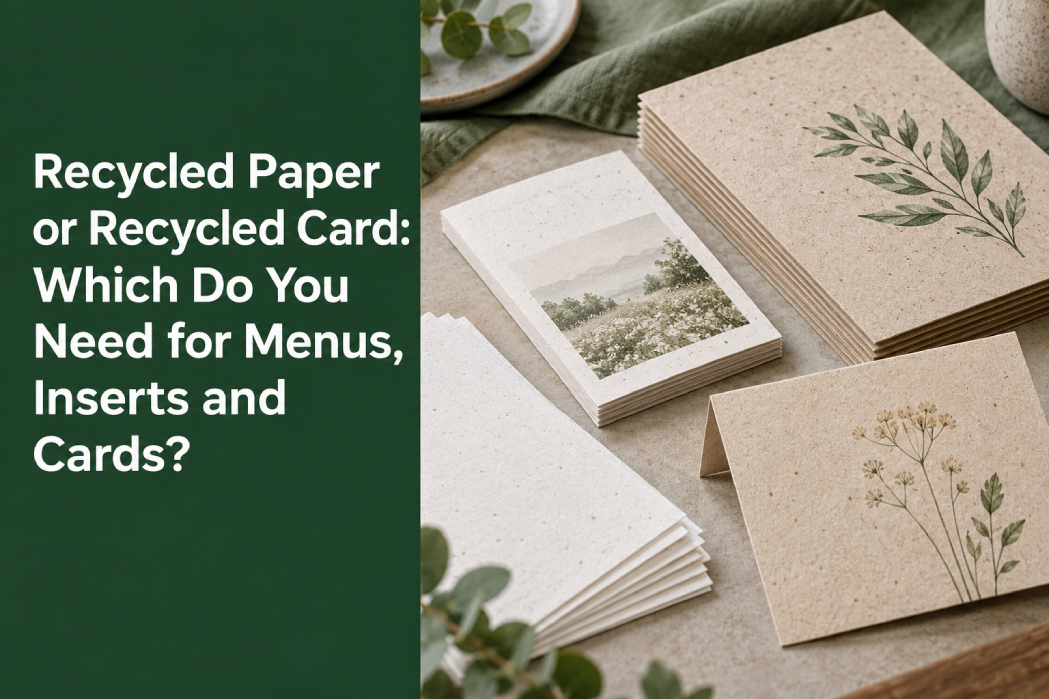
Choosing between recycled paper and recycled card can make a considerable difference to the appearance, feel and practicality of your printed materials. Whether you are producing restaurant menus, packaging inserts, invitations, greeting cards or promotional stationery, selecting the correct material is an important part of achieving the finished result you want.
At The Green Stationery Company, we understand that environmentally responsible printing involves more than simply choosing a product labelled as recycled. Paper weight, texture, colour, recycled content and printing compatibility all influence whether a particular material is suitable for its intended purpose.
Since 1989, we have specialised in supplying recycled paper, card and environmentally preferable stationery products. Our range includes everything from lightweight recycled papers to substantial recycled card, alongside unusual fibres, natural finishes and distinctive colours.
However, one of the questions customers often face is whether they need paper or card for their project.
A restaurant menu, for example, might be printed on relatively lightweight recycled paper if it is designed to be changed regularly. A more substantial menu could benefit from a heavier sheet that feels firmer when handled.
Similarly, a packaging insert may only require a thin sheet of paper, while a greeting card needs enough structure to stand independently.
Understanding these differences helps you choose materials that suit both your design and your budget.
In this guide, we explain the difference between recycled paper and recycled card, explore the importance of GSM and discuss the most suitable options for menus, inserts and cards.
What Is the Difference Between Recycled Paper and Recycled Card?
The main difference between paper and card is generally the weight and rigidity of the material.
Both can be manufactured using recycled fibres, but heavier sheets usually provide greater stiffness and a more substantial feel.
At Greenstat, we supply recycled materials across a wide range of weights.
For example, our range includes 100gsm recycled sugar paper, 140gsm and 150gsm light card, and heavier 300gsm recycled card.
These different weights allow customers to choose materials appropriate for their printing requirements.
Lightweight paper is often suitable for documents that need to be folded, inserted into packaging or handled as individual sheets.
Heavier card may be preferable when the printed item needs to hold its shape or create a more substantial impression.
However, there is no single GSM figure that separates every type of paper from every type of card.
Our product range demonstrates that some lighter card products sit relatively close to heavier paper in weight.
This is why it is important to consider the manufacturer's product description alongside the GSM.
At Greenstat, we encourage customers to think about how the finished item will be used before selecting a material.
Understanding GSM When Choosing Recycled Paper and Card
GSM stands for grams per square metre.
It describes the weight of the material and provides a useful way to compare different papers and cards.
Generally, a higher GSM indicates a heavier sheet, although the exact thickness and stiffness can vary according to the material and manufacturing process.
For example, our Eco Grey Recycled Sugar Paper is available in a 100gsm weight.
This product is suitable for printing applications such as menus, newsletters and leaflets.
We also supply Eco Grey Recycled Light Card in 140gsm.
This offers a heavier alternative while retaining the distinctive appearance of recycled grey paper.
For projects requiring a more substantial material, our Evolution Recycled White Card is available in 300gsm.
This product is particularly relevant to applications such as business cards.
These examples demonstrate why GSM matters.
A lightweight sheet may be ideal for a menu insert, but it may not provide the structure required for a standalone greeting card.
Likewise, a substantial card might be unnecessarily heavy for a leaflet intended to be folded and distributed.
At Greenstat, we recommend choosing the weight according to the finished item's purpose rather than assuming that heavier is always better.
When Should You Choose Recycled Paper?
Recycled paper is often the most practical option when flexibility, ease of handling and straightforward printing are important.
At Greenstat, our recycled paper range includes products suitable for everyday office printing, leaflets, menus and creative applications.
For example, our Eco Grey Recycled Sugar Paper A4 100gsm is manufactured in the UK using 100% post-consumer waste.
The product is described as suitable for inkjet, laser, copier and lithographic printing.
It is also specifically recommended for menus, newsletters and leaflets.
This makes it an option worth considering for businesses producing printed materials that do not require the rigidity of card.
Recycled paper may also be appropriate for packaging inserts.
These are often designed to accompany a product rather than act as a standalone item.
A lightweight sheet can be placed inside a parcel, folded with an order or included alongside other printed information.
However, the most appropriate paper will depend on the design.
If the insert contains substantial text, readability and printing quality should be considered carefully.
If it needs to feel more substantial, a heavier recycled paper may be preferable.
Our team can help customers compare the available options.
When Is Recycled Card the Better Choice?
Recycled card is generally more appropriate when the printed material needs greater structure.
At Greenstat, we supply recycled card in a variety of weights, colours and finishes.
These products can be used for applications where a firmer material is desirable.
For example, greeting cards and invitations often benefit from a heavier sheet that can be handled without feeling too flexible.
Business cards also require a more substantial material than standard printer paper.
Our Evolution Recycled White Card A4 300gsm is manufactured from 100% recycled post-consumer waste.
The product description identifies business cards as a suitable application.
However, it also explains that the weight may make the material unsuitable for some home printers.
This is an important consideration when choosing recycled card.
Although a heavier material may provide the appearance you want, your printing equipment must be capable of handling it.
At Greenstat, we recommend checking your printer's supported media weights before purchasing.
If you are uncertain, requesting a sample can help you establish whether a particular card is appropriate.
Choosing Recycled Paper for Restaurant Menus
Restaurant menus are a good example of why material choice should reflect the intended use.
Some menus are designed to be replaced frequently, while others are intended to remain in use for longer periods.
At Greenstat, we supply several recycled papers suitable for menu printing.
Our Eco Grey Recycled Sugar Paper A4 100gsm is specifically described as ideal for menus.
Its recycled grey appearance can provide an alternative to conventional bright white printing paper.
We also supply Coffee Waste Paper A4 120gsm.
This distinctive paper is manufactured using 95% post-consumer recycled fibres and 5% coffee waste.
The product contains visible coffee flecks and is described as suitable for high-end packaging, menus and creative printing.
For restaurants and cafés looking for a distinctive printed finish, this may be an appealing option.
However, appearance should not be the only consideration.
Think about how often the menu will be handled, whether it will be placed inside a cover and how frequently its contents will change.
A paper menu that is regularly replaced may have different requirements from a menu designed for repeated use.
At Greenstat, we encourage customers to consider these practical details before selecting their material.
Should Restaurant Menus Be Printed on Card?
Recycled card can be an option for menus where a more substantial feel is preferred.
For example, a single-sheet menu may benefit from additional rigidity, particularly if it is presented without a separate cover.
At Greenstat, our range includes light recycled card in weights such as 140gsm and 150gsm.
These materials can provide an alternative to standard paper without necessarily requiring the weight of a much heavier card.
Our Eco Grey Recycled Light Card A3 140gsm is manufactured in the UK using 100% post-consumer waste.
It has a rough recycled feel and is described as suitable for laser and inkjet printing.
This may be worth considering for menu designs where the natural appearance of the material is part of the presentation.
However, it is important to establish whether the selected weight and finish will work with your printing equipment.
If menus need to be folded, the chosen material should also be tested to ensure it produces the intended result.
Our advice is to consider the complete menu design rather than selecting card based on weight alone.
Recycled Paper for Packaging Inserts
Packaging inserts are another application where recycled paper can be particularly useful.
Businesses may include printed information inside parcels for a variety of reasons.
For example, an insert might provide product information, care instructions or a message to the customer.
At Greenstat, we supply recycled papers in different colours and finishes that can be used for creative printed materials.
Our range includes natural brown kraft paper, grey recycled paper and other distinctive options.
Brown kraft paper can be appealing for businesses seeking a natural appearance.
Our Brown Paper Recycled Rough Kraft A4 100gsm is manufactured from 100% post-consumer recycled material.
It has a rough texture and a natural brown colour.
However, our product information makes clear that this paper is not manufactured to graphic-quality printing standards.
It is therefore not guaranteed to run through every office printer.
We recommend requesting samples before purchasing it for a specific printing application.
This is particularly important when inserts need to be produced in larger quantities.
A material that looks attractive should also work reliably with the equipment being used.
When Should Packaging Inserts Be Made From Card?
Some packaging inserts need to provide more structure than a conventional sheet of paper.
For example, a printed product information card may be designed to sit separately inside a package.
A heavier material can create a different impression and may be more appropriate for this type of application.
At Greenstat, we offer recycled light card and heavier card options that can be considered for printed inserts.
The appropriate weight will depend on the size of the insert, its design and how it will be presented.
A small information card may require different material characteristics from a larger printed sheet.
It is also worth considering whether the insert will be folded.
Heavier card can require more careful preparation when folding, particularly if the finished design needs a neat crease.
Before ordering, we recommend testing the intended material with your chosen printing and finishing method.
At Greenstat, we can provide samples of many recycled paper and card products, allowing customers to assess the finish before committing to a larger order.
Choosing Recycled Card for Greeting Cards
Greeting cards are another application where material weight matters.
Unlike a leaflet or packaging insert, a greeting card often needs to fold neatly and maintain its shape.
At Greenstat, our recycled card range includes different colours and weights that can be considered for creative stationery projects.
For example, our selection includes recycled white card, pastel-coloured card and natural-looking materials.
The best choice will depend on the appearance and structure required.
A lightweight card may be suitable for a simple design, while a heavier sheet can create a more substantial feel.
However, selecting the highest GSM available is not necessarily the best approach.
The card must be suitable for printing and folding.
If you are producing greeting cards using a home printer, checking the printer's supported paper weight is particularly important.
Our Evolution Recycled White Card A4 300gsm is a useful example.
Although it offers a substantial recycled card option, our product description warns that it may not be suitable for home printing because of its weight.
We recommend checking compatibility before ordering.
Recycled Card for Invitations and Business Cards
Invitations and business cards often require careful attention to appearance.
The material is part of the finished design, influencing how the printed item feels when handled.
At Greenstat, we supply recycled card suitable for a variety of stationery applications.
Our Evolution Recycled White Card A4 300gsm is made from 100% recycled post-consumer waste.
The product is manufactured in Austria and is listed with FSC, EU Ecolabel and Nordic Swan certifications.
It is also described as suitable for business cards.
For customers seeking a bright white recycled card, this provides an alternative to conventional materials.
However, a natural or coloured card may be more appropriate for a different design.
Our range includes recycled cards with distinctive shades and textures, allowing customers to explore different finishes.
When choosing materials for invitations, consider the intended printing method, whether the card needs to be folded and the overall appearance you want to achieve.
A sample can be particularly helpful when colour and texture are central to the design.
Does Recycled Paper Have to Look Recycled?
One of the advantages of our recycled paper and card range is the variety of appearances available.
At Greenstat, we stock products in bright white, natural white, cream, grey, brown and other colours.
We also supply papers containing unusual fibres and visible inclusions.
This means that customers do not have to choose a visibly recycled appearance unless it suits their project.
For example, a bright white recycled card may be appropriate for business stationery requiring a clean finish.
A natural grey paper might be more suitable for a café menu or creative leaflet.
Our Coffee Waste Paper provides another option, incorporating visible coffee flecks into the sheet.
These differences can influence how printed text and graphics appear.
For this reason, we recommend considering the design alongside the paper colour.
A material with a distinctive texture or visible inclusions may be attractive, but it should not make important information difficult to read.
At Greenstat, we believe that environmentally preferable materials should be selected with the finished application in mind.
How Does Texture Affect Printing?
Texture is another important consideration when choosing between recycled paper and card.
At Greenstat, our range includes smooth papers alongside rougher, more natural-looking materials.
These different finishes can create very different results.
For example, our Eco Grey Recycled Light Card has a rough recycled feel.
Our Brown Paper Recycled Rough Kraft also has a distinctive textured surface.
These characteristics can be attractive for menus, creative stationery and packaging materials.
However, textured paper may behave differently from standard smooth copier paper during printing.
The results will depend on the individual material and printing equipment.
Our terms and conditions explain that many of our recycled papers are not guaranteed for use in every laser or inkjet printer.
This is why we encourage customers to request samples when compatibility is uncertain.
Testing the paper before producing a large print run can help identify whether the material is suitable.
It also provides an opportunity to assess the finished appearance of text, colours and graphics.
Can You Print Recycled Card at Home?
Some recycled card products can be printed using home or office equipment, but compatibility depends on the individual printer.
At Greenstat, our product descriptions identify suitable printing methods where this information is available.
For example, our Eco Grey Recycled Light Card 140gsm is described as suitable for laser and inkjet printing.
However, our Evolution Recycled White Card 300gsm may not be suitable for home printing because of its weight.
These examples demonstrate why it is important to check the specifications before purchasing.
A printer designed primarily for standard office paper may not be able to handle heavier card reliably.
The paper feed mechanism and supported media weights should therefore be considered.
If your printer has a manual feed option or supports heavier media, consult the manufacturer's instructions before using it.
At Greenstat, we recommend testing samples whenever possible.
This allows you to check both the printing result and the way the material passes through your equipment.
Understanding Recycled Content
When choosing recycled paper or card, it is worth examining the recycled content of the product.
At Greenstat, many of our materials are manufactured using 100% recycled fibres.
Some are specifically described as containing post-consumer waste.
For example, our Eco Grey Recycled Sugar Paper and Eco Grey Recycled Light Card are made from 100% post-consumer waste.
Our Evolution Recycled White Card is also manufactured from 100% recycled post-consumer material.
Other products incorporate additional recovered materials.
Our Coffee Waste Paper contains 95% post-consumer recycled fibres and 5% coffee waste.
These details help customers understand the composition of the products they are purchasing.
At Greenstat, we believe that environmental purchasing decisions should be based on clear information rather than broad claims.
Different products have different characteristics, and the most appropriate choice will depend on the intended use.
Why Paper Samples Are Worth Requesting
When choosing recycled paper or card for menus, inserts or stationery, requesting a sample can be one of the most useful steps.
At Greenstat, we understand that photographs and product descriptions cannot always communicate the exact appearance of a material.
Colour, texture and stiffness are often easier to assess when you can handle the paper yourself.
Our terms and conditions explain that recycled paper can vary in shade between manufacturing batches.
This is particularly relevant when choosing natural, coloured or textured materials.
We can provide up to ten paper samples free of charge, subject to the size and postage conditions stated on our website.
If additional samples are required, we can advise on carriage costs.
Testing samples is also important when printer compatibility is uncertain.
Before ordering a large quantity, we recommend printing a sample of the intended design.
This allows you to assess the finished appearance and check whether the paper or card works with your equipment.
How to Choose the Right Material for Your Project
The most useful starting point is to consider what the finished item needs to do.
If you are producing a frequently updated restaurant menu, a suitable recycled paper may provide the flexibility you need.
If you want a single-sheet menu with a firmer feel, light recycled card may be worth considering.
For packaging inserts, the decision will depend on whether the item is intended to be a simple information sheet or a more substantial printed card.
Greeting cards, invitations and business cards may require heavier materials, although printing and folding requirements should still be considered.
At Greenstat, we encourage customers to assess GSM, finish, colour and compatibility together.
It is also important to consider the recycled content and any environmental certifications associated with the chosen product.
Our range provides options for different applications, but no single material is suitable for every project.
Choosing carefully can help you achieve the appearance you want without purchasing a material that is unnecessarily heavy or unsuitable for your equipment.
Why Choose The Green Stationery Company?
At The Green Stationery Company, we have been supplying recycled paper, card and environmentally preferable stationery products since 1989.
We were established as a green business from the outset and continue to focus on providing alternatives to conventional office and printing supplies.
Our range includes recycled white paper, natural brown kraft, coloured and textured papers, light card and heavier recycled card.
We also stock products manufactured using unusual fibres and recovered materials.
This variety allows customers to explore different options for menus, inserts, invitations, business cards and other printed materials.
We understand that choosing the correct paper or card can be difficult, particularly when colour, texture and printer compatibility are important.
Our team is available to provide information about the products we supply and help customers identify suitable options.
Where appropriate, we can also arrange samples so that materials can be assessed before purchase.
Our aim is to make environmentally responsible purchasing straightforward, practical and accessible.
Find the Right Recycled Paper or Card for Your Next Project
So, should you choose recycled paper or recycled card?
The answer depends on how your printed materials will be used.
Recycled paper is often suitable for menus, leaflets and lightweight inserts, while recycled card can provide additional structure for invitations, greeting cards and business cards.
However, GSM is only one part of the decision.
Colour, texture, recycled content, printing compatibility and the intended finish should all be considered.
At Greenstat, we offer an extensive selection of recycled paper and card to suit different printing and creative requirements.
Whether you are producing restaurant menus, packaging inserts or bespoke stationery, we can help you explore the available materials.
By choosing products that suit your application, you can combine practical printing requirements with more environmentally responsible purchasing.
Looking for recycled paper or card for your next project? Explore our range at Greenstat or contact The Green Stationery Company on 01225 480 556 or sales@greenstat.co.uk for advice on materials, weights, finishes and samples.
